
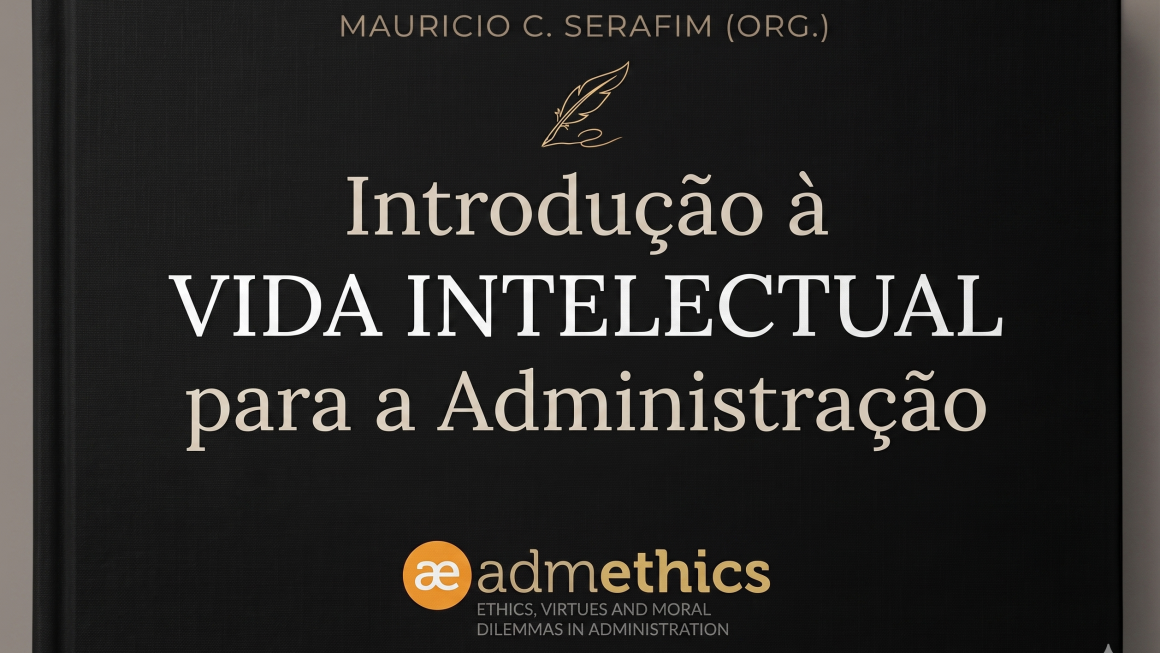
New AdmEthics book publication: Intellectual life for administration
The collection brings together nine essays on the cultivation of the intellectual life as a condition for the formation of the administrator. The argument that articulates the chapters is that management, understood as human action and not as a technique for optimizing resources, requires the exercise of prudence in the Aristotelian-Thomistic sense, that is, the […]

Why Putting Experts in a Room Isn’t Enough to Solve Complex Problems
Nicolas Rufino dos Santos An epistemic framework is the worldview that expresses a researcher’s values and intentions, even if implicitly. It is through this analytical dimension that one can extract the ideological roots of scientific theories. The selected scopes and the interpretations drawn from them reveal the epistemic framework (GARCÍA, 1994). To illustrate the importance […]

The Ethical Man of Time and the Challenges of Modernity
Por Bruno Trindade Is man always an end, or can he be treated as a means? I want to argue, with limitedscope, that the dignity of man does not allow him to be used as a means. Furthermore, Ihope to present and analyze a factor that promotes the social and practical degradation ofman’s ontological quality. […]

Artificial Intelligence in Decision-Making
Por Sandro José Risso Introduction Artificial Intelligence has generated a climate of uncertainty in academic production. While it can function as a valuable ally, it may also become a significant threat to academic research. With this tension in mind, this text was produced using ChatGPT by OpenAI as the sole generative tool, apart from the […]

AI Literacy as a Mechanism for Democratic Defense: From the Technical to the Socio-technical
By Ana Luize Corrêa Bertoncini (based on the closing lecture given for the “Special Topics III – Politics and Public Policy” course in the Public Administration program at ESAG/UDESC, semester 2025/1) In the contemporary debate on integrating technology into public management, we face a dangerous form of reductionism. Frequently, so-called “artificial intelligence literacy” (or AI […]

Analysis of Frankenstein (2025) from the perspective of Transcendental Anthropology
Mauricio C. Serafim | 20.11.2025 The film illustrates the conflict between technical production and the personal dimension. The Creature’s misfortune does not lie in its monstrous constitution, but in the systematic denial of fully manifesting its transcendentals (free coexistence, personal knowing, personal loving), a direct result of its creator’s inability to overcome the limit of […]

To Serve the Public, the Right Question Is Not “What to Do?” but “Who to Be?”: Some Counterintuitive Ideas About Public Management
Mauricio C. Serafim When we think of public management, the image that often comes to mind is that of a universe governed by laws, processes, and complex bureaucracy. It is commonly believed that excellence lies in the strict application of rules. However, true effectiveness in public management may not rest in the unreflective fulfillment of […]

The Mediation Between Stoic Virtue and Humean Utility: Contributions from Adam Smith
Renata Biana da Silva Smith generally recognized the moral importance of both views (stoic virtue and humean utility). However, he also pointed out the weaknesses demonstrated by each, seeking to promote the use of a new principle that could reconcile classical virtue with the need to consider “self-love”. Virtue theory, associated with the stoics and […]

O Homem Parentético
Por, Prof. Maurício C. Serafim Vídeo didático criado no Google Notebooklm a partir dos textos:

An Overview of Methodology in Social Sciences
Based on Quivy & Campenhoudt (1998), the success of a scientific research study depends on the correct execution of a number of procedures that require different skills. This set of steps isn’t just a simple collection of isolated techniques, but a comprehensive journey that has meaning and requires reinvention with each new research project. When […]